
Choosing your market
In one sentence: a small contractor makes money by being very good at a narrow kind of work for a known set of customers, so choose your market on purpose instead of bidding everything.
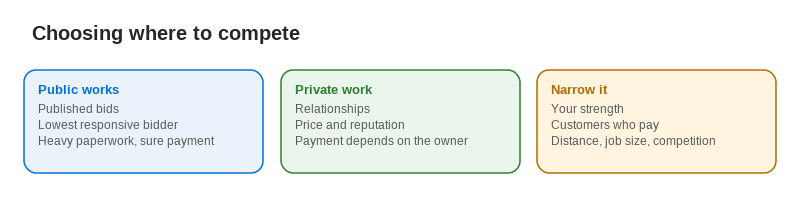
Public or private
| Public works | Private work | |
|---|---|---|
| Finding work | Published bids, open to all qualified bidders | Relationships and invitations |
| Award | Usually lowest responsive, responsible bid | Price, relationship, reputation |
| Paperwork | Heavy: prevailing wage, certified payroll, bonds, submittals | Lighter, depends on the owner |
| Payment | Slow but sure | Varies with the owner's finances |
See What makes a job public works in California.
Prime or sub
- As a sub, you deal with one GC, a narrower scope and less paperwork, but the GC controls schedule and payment.
- As a prime, you deal with the owner directly and control the job, but carry bonding, coordination and all the risk. See From sub to prime.
Narrowing down
- Your strength: which work do you do better and cheaper than others? (Use job cost history, not feelings.)
- Customers: which agencies, GCs or owners pay well and treat subs fairly?
- Geography: how far can crews travel and stay profitable?
- Job size: the range your bonding, cash and crews can carry.
- Competition: how many bidders show up, and how close are the results?
Using bid results
Public bid results show who bids, how often and how far apart. Track them for your target agencies to see where you're competitive. See Finding public bids.
PM notes
Write your target market in one sentence and check every bid against it. "Caltrans and city electrical work under $3 million within 60 miles" is a market; "anything electrical" isn't.
Common mistakes
- Bidding every job you hear about.
- Choosing a market by revenue instead of profit.
- Ignoring how a customer pays until the first job.