
Job costing: knowing what each job really made
In one sentence: job costing means every cost lands on a job and a cost code, so you can compare actual to estimate during the job, not just discover the result at year end.
The building blocks
- Jobs: one per contract (and one for shop or overhead time).
- Cost codes: the same codes the estimate used, by activity (trenching, conduit, pull boxes, wire, testing) or by bid item on unit-price work.
- Cost types: labor, burden, material, equipment, subcontract, other.
Coding costs
- Labor: time cards by job and cost code every day. A whole day on "general" teaches you nothing.
- Burden: payroll taxes, workers' comp, benefits; allocated as a percentage of labor or by hour.
- Material: every supplier invoice coded when it's entered, using the PO.
- Equipment: owned equipment charged at an internal hourly or daily rate; rentals at cost.
Reading the report
| Column | What it tells you |
|---|---|
| Estimate | What you bid |
| Cost to date | What you've spent |
| Percent complete | How much of the work is done (from the field, not from cost) |
| Projected final cost | What the job will cost if trends hold |
| Projected margin | What you'll actually make |
The key number is percent complete from the field. Cost to date divided by budget is not progress; it's spending.
Closing the loop
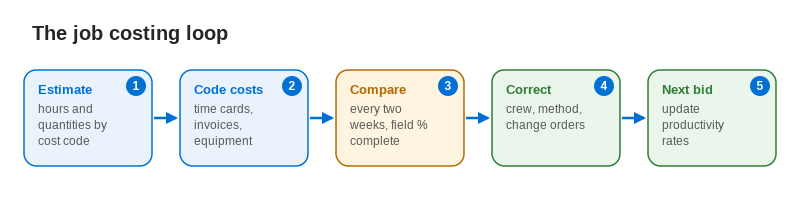
At the end of each job, compare actual productivity (feet of conduit per crew-day, boxes set per day) with the estimate, and update the estimating database. That's how the next bid gets sharper.
PM notes
Review job cost every two weeks with the foreman. Problems found at 30% complete can be fixed; problems found at closeout can only be explained.
Common mistakes
- Measuring progress by money spent instead of work done.
- Time cards without cost codes.
- Never comparing final productivity with the estimate.