
Union or open shop
In one sentence: signing with a union gives you trained workers from the hall, a set wage and benefit package and access to work that requires it, in exchange for the agreement's rules on pay, hiring and how work is staffed.
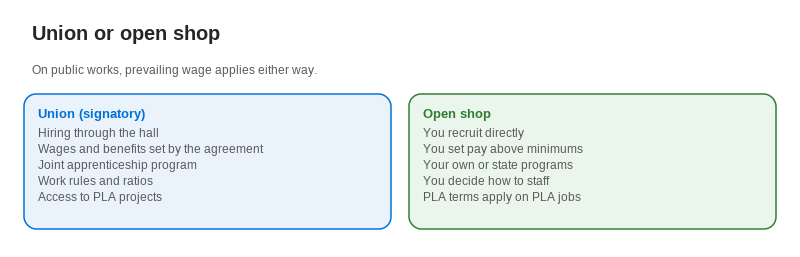
What changes when you sign
| Topic | Union (signatory) | Open shop |
|---|---|---|
| Hiring | Through the hall, under the agreement's rules | You recruit directly |
| Pay and benefits | Set by the agreement, paid into trust funds | You set them, above legal and prevailing minimums |
| Training | Apprenticeship through the joint program | Your own, or state-approved programs |
| Flexibility | Work rules, ratios and jurisdiction set by the agreement | You decide |
| Market | Access to projects with labor agreements | Some projects require union labor |
Project labor agreements
Some public projects are built under a project labor agreement (PLA). Open-shop contractors can usually bid, but must follow the PLA's terms on that job, such as hiring through the hall and paying into trust funds. Read the PLA before bidding.
On public works
Prevailing wage applies either way. Union and open-shop contractors pay at least the same total rates on public works; the difference is how benefits are provided. See Prevailing wage and Certified payroll.
Questions before signing
- Which agreement, which local, which classifications and which area?
- What are the total hourly costs (wages, benefits, training) for each classification?
- Hiring rules: can you name-request your own people?
- Apprentice ratios and work rules.
- What happens to your existing employees?
- How do you leave later, and what liabilities (for example pension withdrawal) could follow?
PM notes
This is a long-term decision. Talk to a labor attorney and to other contractors of your size on both sides.
Common mistakes
- Signing without pricing the full hourly cost by classification.
- Bidding a PLA job without reading the PLA.
- Not asking about obligations if you later stop being signatory.