
Overhead and markup: pricing so the company earns money
In one sentence: every job must cover its direct costs, its share of the office and yard, and a profit, so you need to know your overhead per year before you can price a job correctly.
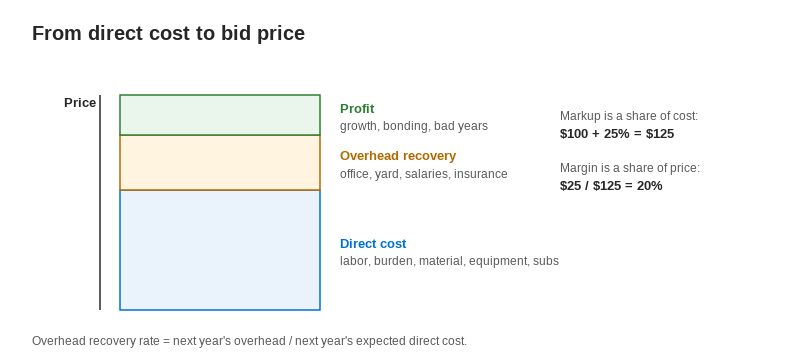
What overhead is
Costs that keep the company running but don't belong to one job:
- office rent, utilities, phones, software;
- office salaries (owner, estimator, office manager, PM time not charged to jobs);
- insurance not charged to jobs, licenses, bonds' annual fees, professional fees;
- vehicles and tools not charged to jobs;
- marketing, training, bidding costs.
The overhead budget
- List next year's overhead costs, month by month.
- Estimate next year's volume of work (revenue or direct cost).
- Divide: overhead / expected direct cost = the overhead recovery rate to add to every job's direct cost.
Example: $400,000 of overhead on an expected $2,000,000 of direct cost means each job needs 20% on top of direct cost just to pay the office.
Markup vs margin
- Markup is added to cost: cost $100 + 25% markup = $125 price.
- Margin is a share of price: $25 profit on a $125 price is a 20% margin.
Mixing the two is one of the most common ways contractors underprice.
Profit
Profit is not what's left over; it's a line in the price. It pays for growth, bonding capacity, equipment and bad years.
When volume drops
If the company does less work than planned, overhead per job goes up. That's the moment to cut overhead or find work, not to drop prices below cost.
PM notes
Know your break-even volume: the amount of work at which overhead is just covered. Below it, every month loses money.
Common mistakes
- Applying a markup percentage someone else uses instead of your own overhead.
- Confusing markup with margin.
- Cutting price below full cost to "keep the crew busy" for months.