
Financial statements a surety and a bank want to see
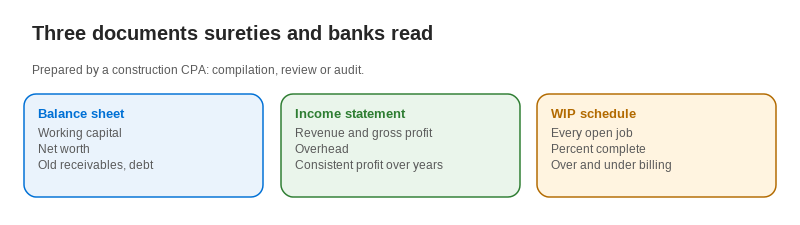
In one sentence: sureties and banks judge a contractor on three documents, the balance sheet, the income statement and the work-in-progress schedule, and on how much a CPA stands behind them.
Balance sheet
What the company owns and owes on one date. Sureties look hardest at:
- working capital: current assets minus current liabilities;
- net worth (equity);
- receivables that are old or doubtful;
- debt and who it's owed to.
Income statement
Revenue, cost of work and overhead over a period. The question is whether the company makes money consistently, and whether gross profit holds up as volume grows.
The WIP schedule
The work-in-progress schedule lists every open job:
| Column | Meaning |
|---|---|
| Contract value | Including approved changes |
| Estimated total cost | Current estimate at completion |
| Cost to date | Spent so far |
| Percent complete | Cost to date / estimated total cost |
| Earned revenue | Contract value × percent complete |
| Billed to date | What's been invoiced |
| Over / under billing | Billed minus earned |
Overbilling (billed more than earned) means you have the owner's cash in advance; it's a liability, and too much can hide a losing job. Underbilling (earned more than billed) means you've done work you haven't billed, often unsigned change orders or a job going wrong. Sureties read both closely.
Levels of CPA work
- Compilation: the CPA formats your numbers, no assurance.
- Review: the CPA does limited checks and gives limited assurance.
- Audit: full testing and an opinion.
Larger bonding programs usually require a review or audit, prepared by a CPA who knows construction and uses percentage-of-completion accounting.
PM notes
The WIP schedule is only as good as the estimated costs to complete. Update them honestly every quarter. See Job costing: knowing what each job really made.
Common mistakes
- Giving a surety tax returns instead of construction financial statements.
- Optimistic cost-to-complete numbers that hide a losing job.
- A CPA without construction experience.