
From sub to prime
In one sentence: as a prime you hold the owner's contract, the bonds and the coordination of every sub, so step up on jobs where your own trade is most of the work.
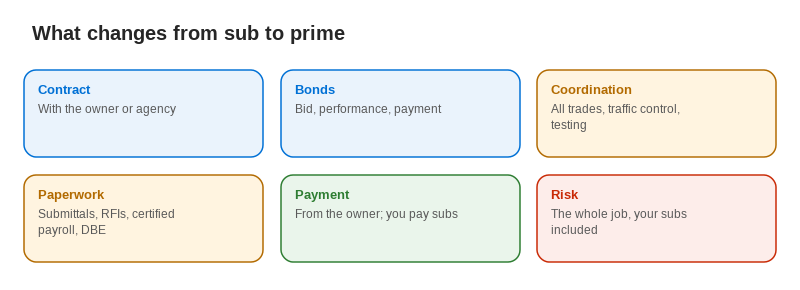
What changes
| Topic | As a sub | As a prime |
|---|---|---|
| Contract | With a GC | With the owner or agency |
| Bonds | Sometimes | Bid, performance and payment bonds, usually |
| Coordination | Your scope | All trades, traffic control, testing, schedule |
| Paperwork | Your submittals and payroll | Everyone's: submittals, RFIs, certified payroll, DBE, closeout |
| Payment | From the GC | From the owner; you pay the subs |
| Risk | Your scope | The whole job, including your subs' failures |
Where specialty primes win
Agencies often advertise work where one trade is most of the scope: on Caltrans, electrical jobs like lighting, signals, ramp metering and communications are bid with an electrical contractor as prime. See What a Caltrans electrical contractor does.
Making the step gradually
- Start with small jobs within your trade where the other trades are minor.
- Build relationships with reliable subs (traffic control, paving, striping, civil).
- Line up bonding before you bid. See Bonding capacity: how it is set and how to grow it.
- Add the office capacity for prime paperwork: submittals, RFIs, certified payroll, DBE, subcontractor listing. See Listing subcontractors and DBE requirements on federal-aid jobs.
- Learn from each job's closeout before bidding bigger.
PM notes
Your subs' performance becomes yours. Choose them on reliability, insurance and payroll compliance, not just price.
Common mistakes
- Bidding as prime without bonding lined up.
- Underpricing the coordination and paperwork.
- Choosing subs on lowest price alone.