
Saying no: which jobs to pass on
In one sentence: every bid costs estimating time and every job uses crews, cash and bonding, so decide on purpose which ones to pursue, and walk away from the rest.
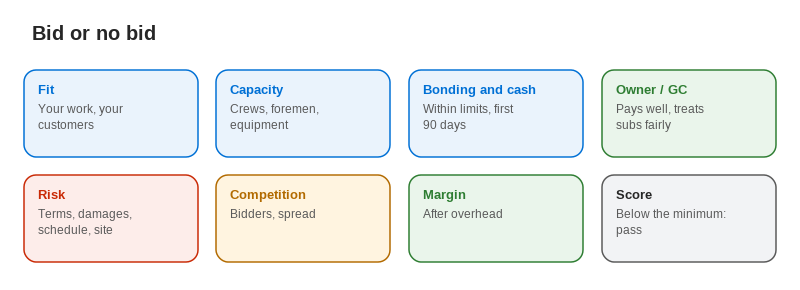
A bid/no-bid checklist
Score each from 1 to 5:
| Question | What to check |
|---|---|
| Fit | Is this the work and customer type you target? See Choosing your market |
| Capacity | Crews, foremen and equipment available when it runs? |
| Bonding and cash | Within limits? What does the first 90 days of cash look like? |
| Owner / GC | How do they pay and treat contractors? |
| Risk | Unusual terms, liquidated damages, schedule, site conditions, design quality |
| Competition | How many bidders usually, and how close? |
| Margin | Realistic margin after overhead? |
Set a minimum score; below it, don't bid.
Red flags
- Contract terms that shift design risk or unlimited damages to you.
- A schedule that can't be met with your crews.
- An owner or GC known for slow payment or disputes.
- A scope far outside your experience.
- Bidding only to keep the crew busy at a loss.
Saying no well
Thank the GC or owner, say you're not able to bid this one, and ask to stay on their list. A clear no is better than a weak bid.
PM notes
Track your hit rate by customer and job type. If you win 1 in 20 with a GC, your estimating time is better spent elsewhere.
Common mistakes
- Bidding every invitation.
- Reading the contract terms only after winning.
- Taking a job you can't staff because the price was right.