
Cores and other destructive checks
In one sentence: a core is the reference: a sample of the actual concrete, tested in a lab for strength and examined for what's inside, used to calibrate the non-destructive methods.
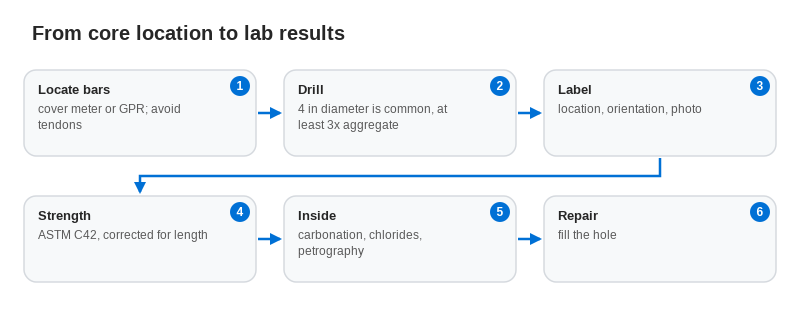
When to core
- When strength matters for a structural decision: load rating, change of use, retrofit design.
- To calibrate Rebound hammer and Ultrasonic pulse velocity results.
- To see what's inside: depth of cracks, carbonation, delamination planes, chloride profile, reactive aggregate.
Planning
- Locate bars first (see Cover meters and rebar locating and Ground-penetrating radar) and avoid cutting them, and never cut post-tensioning tendons.
- Core where stresses are low and the structure can spare it; the engineer of record should agree on locations.
- Diameter at least about 3 times the maximum aggregate size; 100 mm (4 inch) is common.
- Enough cores for a statistical result: often at least three per area of concrete being assessed.
Testing strength
ASTM C42 covers obtaining and testing drilled cores: conditioning, trimming the ends, capping, and correcting for the length-to-diameter ratio. Core strength is usually lower than the strength of standard cylinders made from the same concrete, and codes such as ACI 318 and ACI 562 say how to judge it.
Other things a core shows
- Depth of carbonation (phenolphthalein).
- Chloride content at different depths.
- Petrographic examination for alkali-silica reaction, freeze-thaw damage, air content.
- Thickness and layering.
After coring
Fill the hole with a suitable repair mortar, label each core with location and orientation, and photograph it before it goes to the lab.
Common mistakes
- Coring through a bar and weakening the member.
- Too few cores to say anything about the concrete.
- Not recording the core's location and orientation.