
Rebound hammer
In one sentence: the rebound hammer measures how much a spring-driven mass bounces off the concrete surface, which tells you about surface hardness, and with calibration against cores, a rough idea of strength.
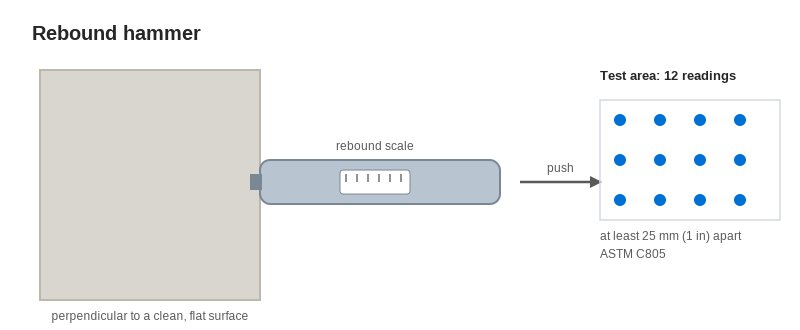
How it works
A spring drives a plunger mass against the concrete. The rebound number is read on a scale or a digital display. Harder, stronger concrete gives a higher rebound. The test is standardized in ASTM C805 (and EN 12504-2 in Europe).
Doing it properly
- Choose test areas on smooth, flat, clean concrete, away from edges and visible defects. Grind off laitance or coatings with the abrasive stone.
- Hold the hammer perpendicular to the surface. Note the direction (horizontal, up, down), which changes the reading.
- Take about 10 to 12 readings per area, at least 25 mm (1 inch) apart, never twice in the same spot.
- Discard outliers as the standard describes, and report the median or average.
What affects the reading
- Surface texture and moisture (wet concrete reads lower).
- Carbonation: a carbonated surface is harder and reads higher.
- Aggregate type, age, and whether a bar or a stone sits right below the plunger.
- Thin or small members that vibrate under the impact.
What it's good for
- Comparing areas of the same concrete to find weaker zones.
- Estimating strength only when correlated with cores from the same structure. See Cores and other destructive checks.
- Combined with Ultrasonic pulse velocity ("SonReb" methods) for a better strength estimate.
Its limits
It only sees the first few centimeters. A reading never replaces a core when strength matters for a structural decision.
Common mistakes
- Converting rebound numbers to strength with the curve on the hammer, without cores.
- Testing on rough or wet surfaces.
- Testing old, carbonated concrete without accounting for the hard surface.