
Writing an inspection report
In one sentence: the report is the product: it must let the owner decide what to do, and let the next inspector find and compare every defect you recorded.
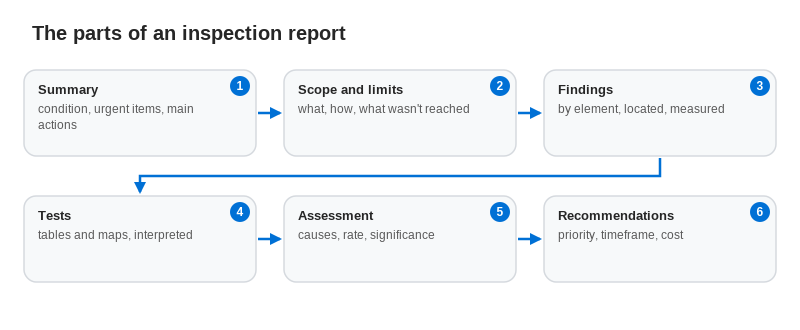
Structure
- Summary: overall condition, urgent findings, main recommendations. One page an owner can read alone.
- Scope and methods: structure, inspection type, date, team, access, tests run and the standards followed, limitations (what couldn't be inspected and why).
- Description of the structure: type, materials, dimensions, history.
- Findings by element: defects with location, size, condition state and photo references; comparison with the previous inspection.
- Test results: tables and maps (cover, potentials, delamination, thickness), with interpretation.
- Condition ratings. See Condition ratings: NBI 0 to 9 and element condition states.
- Assessment: likely causes, rate of deterioration, structural significance.
- Recommendations: each with a priority, a timeframe and, where possible, an order-of-magnitude cost.
- Appendices: defect sheets, photo log, drawings marked with defect locations, instrument calibration records.
Recommendations owners act on
| Priority | Typical timeframe | Example |
|---|---|---|
| Urgent | Immediately or within days | Load restriction, barrier, temporary shoring |
| High | Within a year | Repair of spalls with exposed corroded bars |
| Medium | Within a few years | Joint replacement, coating repair |
| Monitor | At next inspection | Crack to be measured again |
Be specific: "Repair 12 square feet of spalled concrete at pier 2, south face, with exposed bars", not "Repair concrete as needed".
Photos
Number every photo, give it a caption with location and what it shows, and include a scale. Take an overview photo before the close-up.
Words to avoid
"Minor", "some", "appears" without measurements. Every qualitative word should come with a number.
Common mistakes
- A summary that doesn't say whether anything is urgent.
- Recommendations without priorities.
- Limitations of access not stated, so readers assume everything was inspected.