
Cover meters and rebar locating
In one sentence: a cover meter uses a magnetic field to locate reinforcing bars under the surface and estimate how deep they are, which tells you about durability and where it's safe to drill or core.
How it works
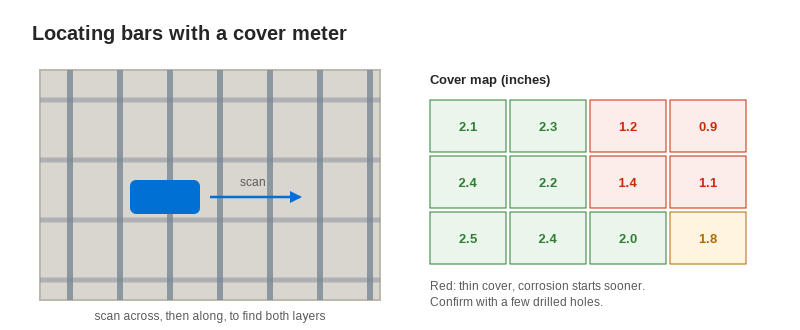
The probe creates an electromagnetic field; steel bars change it. The instrument shows when the probe is over a bar and estimates the cover (the concrete depth to the bar). Some instruments also estimate bar diameter. Guidance is in BS 1881-204 and ACI 228.2R.
Doing it
- Calibrate or check the instrument on a known block.
- Scan in one direction to find the outer layer of bars and mark them. Then scan across them to find the second layer.
- Record cover at a grid of points; good instruments store a map.
- Confirm a few points by drilling a small hole or at an existing spall.
Why cover matters
- Durability: too little cover lets chlorides and carbonation reach the steel sooner, which starts corrosion. Compare measured cover with what the drawings and codes required. See Half-cell potential and corrosion testing.
- Safety when drilling or coring: avoid cutting bars or tendons. See Cores and other destructive checks.
- Checking construction: whether bars are where the drawings put them.
Limits
- Accuracy drops with depth (typically good to around 100 mm, about 4 inches) and with closely spaced bars or several layers.
- Doesn't detect non-magnetic reinforcement such as stainless or fiber-reinforced bars well.
- For deep bars, dense reinforcement or post-tensioning ducts, use Ground-penetrating radar.
Common mistakes
- Assuming bar diameter from the meter without confirming.
- Scanning only one direction and missing the second layer.
- Coring on a meter scan alone near post-tensioning tendons.