
Sounding, chain drag and impact-echo
In one sentence: delaminated concrete sounds hollow when struck; a hammer or a dragged chain finds it quickly, and impact-echo uses the same idea with instruments to measure thickness and find hidden flaws.
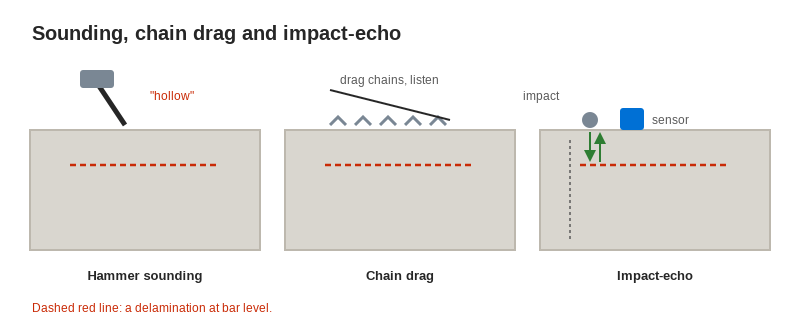
Hammer sounding
Tap the concrete with a hammer; sound concrete rings, delaminated concrete gives a dull, hollow sound. Mark the boundary of each hollow area with chalk and measure it. It's the most common test on soffits, columns and walls.
Chain drag
On bridge decks and slabs, drag a set of chains across the surface and listen. Hollow areas sound different. ASTM D4580 describes sounding of bridge decks. Traffic noise and asphalt overlays make it harder.
Impact-echo
A small steel ball or impactor strikes the surface, sending a stress wave into the concrete. A transducer next to it records the waves reflecting between the surface and the back of the member, or a flaw. The frequency of the reflections gives the depth: a shallow delamination returns a different frequency than the full thickness. Standardized in ASTM C1383 for thickness measurement.
Uses:
- Thickness of slabs, walls and tunnel linings from one side.
- Delaminations and voids, including in grouted post-tensioning ducts.
- Scanning versions roll along the surface and map a deck quickly.
Related methods
- Impulse response (ASTM C1740): a hammer with a load cell and a velocity sensor; finds areas of poor support or delamination over larger areas.
- Infrared thermography: delaminations heat and cool differently from sound concrete in the sun.
PM notes
Sounding is cheap and quick. Use it first, then instruments where the sound is ambiguous or the deck is overlaid.
Common mistakes
- Sounding a deck in heavy traffic noise without traffic control.
- Marking only the center of a hollow area instead of its boundary.
- Using impact-echo without knowing the wave speed in the concrete.