
Half-cell potential and corrosion testing
In one sentence: a half-cell survey measures the electrical potential of the reinforcement through the concrete; more negative values mean a higher probability that the steel is actively corroding.
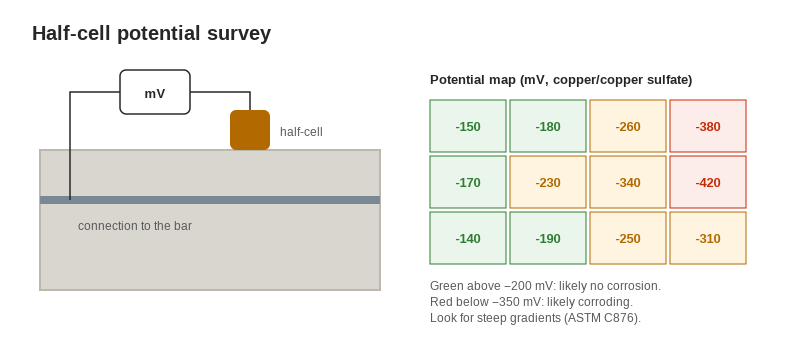
How it works
A reference electrode (the half-cell, often copper/copper sulfate) is placed on the wetted concrete surface, and a voltmeter is connected to the reinforcement through a small exposed point. The potential between them is read on a grid. Standardized in ASTM C876.
Reading the results (copper/copper sulfate electrode)
| Potential (mV) | Probability of active corrosion (per ASTM C876) |
|---|---|
| More positive than −200 | Greater than 90% chance of no corrosion |
| −200 to −350 | Uncertain |
| More negative than −350 | Greater than 90% chance of corrosion |
These thresholds are a guide. Look at gradients on the map: a sharp change between neighboring points shows active corrosion better than a single number.
Doing it
- Locate bars and check continuity between test points (see Cover meters and rebar locating).
- Pre-wet the surface so the reading is stable.
- Read on a grid (for example 0.5 to 1 m), and map with contours.
Companion tests
- Chloride content at several depths, from dust samples or cores: how much salt reached the bar level.
- Carbonation depth: spray phenolphthalein on a fresh break; uncolored concrete is carbonated.
- Resistivity: low resistivity means corrosion can proceed faster.
- Corrosion rate with linear polarization instruments, when the rate matters.
Limits
Coatings, epoxy-coated bars, very dry or saturated concrete and cathodic protection all affect readings.
Common mistakes
- Testing without checking electrical continuity of the bars.
- Reading a single potential against the table instead of mapping gradients.
- Surveying epoxy-coated reinforcement as if it were plain steel.