
Apprentices on public works
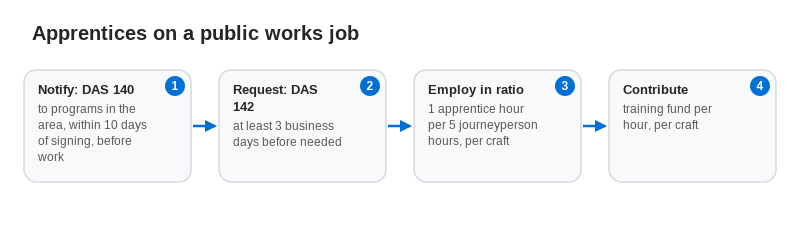
In one sentence: on contracts of $30,000 or more, each apprenticeable craft must send contract award information to apprenticeship programs, request apprentices, and employ at least one apprentice hour for every five journeyperson hours by the end of the job.
When it applies
All public works contracts of $30,000 or more carry the obligation, for each craft or trade that is apprenticeable under the prevailing wage determination. The obligation is per contractor and per craft.
The steps
- Notify (DAS 140). Before starting work, and within 10 days of signing the contract, send contract award information to the apprenticeship programs that can supply apprentices to the job, for each craft you will use. If you are not already approved to train, send it to every program in the area for that craft.
- Request (DAS 142). When you need apprentices, ask the program to dispatch them, at least three business days before they are needed.
- Employ in ratio. At least one hour of apprentice work for every five hours of journeyperson work, per craft, counting straight-time hours, measured over the whole job. Apprentices must be registered in an approved program, paid the apprentice rate for their step, and supervised as the program requires.
- Contribute to training funds for each apprenticeable craft, at the rate shown in the determination, to an approved program or the California Apprenticeship Council.
Exemptions
Some situations exempt a contractor or craft, for example a contract under $30,000, or an approved exemption from DAS. Keep the exemption letter in the job file.
PM notes
Plan the ratio from the start. It's easier to add an apprentice to a crew in month one than to make up the hours in the last week.
Common mistakes / what agencies actually check
- Sending the DAS 140 after the job is finished.
- Counting overtime hours toward the ratio.
- Paying the apprentice rate to a worker who isn't registered as an apprentice.