
Prevailing wage
In one sentence: every worker on public works must be paid at least the prevailing wage for the work they actually do, in the county where the job is, as published by DIR for the bid advertisement date.
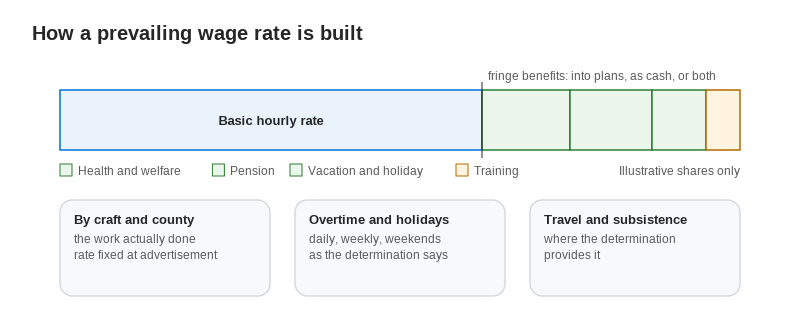
Finding the right rate
DIR publishes prevailing wage determinations for each craft (inside wireman, laborer, operating engineer, and many more) by county. Use the determination in effect on the date the bid was advertised. Many determinations include predetermined increases on known dates, marked in the document; those apply during the job.
Pay by the work performed, not by job title. A worker who pulls wire for half a day and digs trench the other half is paid each rate for those hours, and your payroll must show both.
What the rate includes
- Basic hourly rate.
- Fringe benefits: health and welfare, pension, vacation and holiday, training, other.
- Overtime and holiday rates and the hours that trigger them.
- Travel and subsistence where the determination provides it.
- Training fund contributions for apprenticeable crafts.
Fringe benefits: cash or plan
You can pay fringe benefits into bona fide plans, as cash on the paycheck, or a mix, as long as the total meets the rate. Since January 1, 2026 (AB 889), California requires employers to annualize fringe benefit credits, so that a plan contribution counts only for the hours actually worked across all jobs, public and private, and to keep records that show it.
Overtime
The determination says when overtime applies: daily hours over 8, weekly over 40, Saturdays, Sundays, holidays and night shifts, depending on the craft. Failing to pay the prevailing overtime rate carries its own penalty.
Changes coming
For prime contracts of $35 million or more, AB 1198 will apply new determinations mid-project from July 1, 2027. Smaller contracts keep the rates fixed at advertisement, plus the predetermined increases.
PM notes
Print the determinations for every craft you might use on the job and keep them in the job file, with the advertisement date written on top. It is the first thing an auditor asks for.
Common mistakes / what agencies actually check
- Paying everyone the laborer rate when part of the work is electrical.
- Using the current determination instead of the one in effect on the advertisement date.
- Counting a fringe benefit plan contribution against hours on a public job without annualizing it.