
Insurance requirements on public contracts
In one sentence: the contract's insurance section lists coverages, limits and endorsements; send it to your broker before you bid, because a missing endorsement can hold up the contract signature.
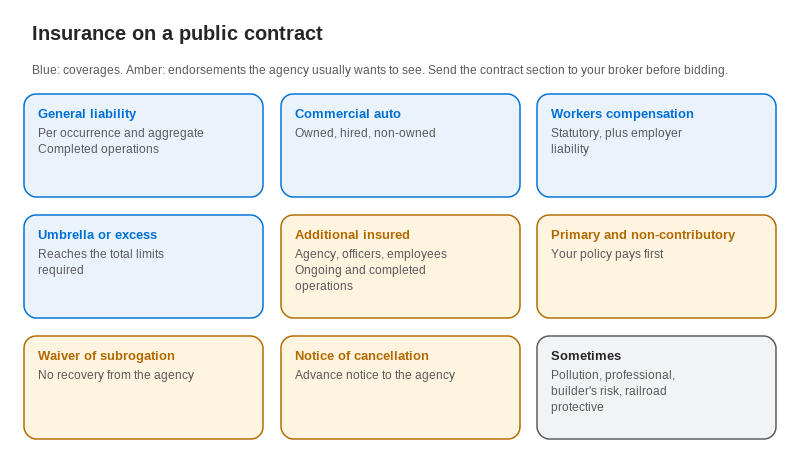
Coverages you'll be asked for
- Commercial general liability (CGL): per-occurrence and aggregate limits, often with completed operations.
- Commercial auto liability: owned, hired and non-owned vehicles.
- Workers' compensation at statutory limits, plus employer's liability.
- Umbrella or excess liability on larger jobs to reach the required total.
- Sometimes: pollution liability, professional liability (design-build), builder's risk, railroad protective liability near tracks.
Endorsements that matter
- Additional insured: the agency (and often its officers, employees and consultants) named as additional insured on your CGL and auto policies, including completed operations.
- Primary and non-contributory: your policy pays first, without asking the agency's insurance to share.
- Waiver of subrogation: your insurer gives up the right to recover from the agency.
- Notice of cancellation: advance notice to the agency.
Many agencies want copies of the endorsements themselves, not just the certificate of insurance.
Subcontractors
The contract usually requires you to pass the same requirements down to subs, sometimes with lower limits. Collect their certificates and endorsements before they mobilize.
PM notes
Keep a one-page summary of each job's insurance requirements in the job file, with expiration dates. Certificates expire during long jobs, and some agencies hold payment until a current one is on file.
Common mistakes / what agencies actually check
- Assuming the certificate of insurance is enough when the contract asks for the endorsements.
- Subs working without the agency named as additional insured.
- Missing a policy renewal date in the middle of the job.