
Contractor licenses for public works
In one sentence: the Contractors State License Board license is the first gate: the class must fit the work you bid, and on public works it must be active when you submit the bid, not just when you start.
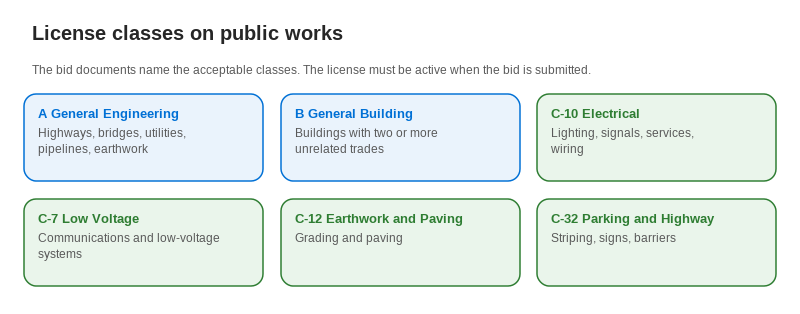
The classes you will see most on public works
| Class | Name | Typical public work |
|---|---|---|
| A | General Engineering | Highways, bridges, utilities, earthwork, pipelines, and the civil side of electrical work |
| B | General Building | Buildings, where the contract involves at least two unrelated trades |
| C-10 | Electrical | Lighting, signals, service equipment, wiring |
| C-7 | Low Voltage Systems | Communications and low-voltage systems |
| C-12 | Earthwork and Paving | Grading, paving |
| C-32 | Parking and Highway Improvement | Striping, signs, barriers |
| C-61/D-xx | Limited specialty | Narrow scopes such as fencing or sign installation |
Bid documents state which classes are acceptable, sometimes as "Class A or C-10 at the time of bid". Read that line before anything else.
When the license must be active
California's Business and Professions Code requires that a contractor bidding public works be licensed in the right class when the bid is submitted. An unlicensed bid is nonresponsive and can bring penalties. Federal-aid jobs follow a slightly different timing rule set by federal law, but the bid documents will say so.
Your subcontractors
Every sub needs a license in the class for its own scope, and its license number goes on your subcontractor list. A missing or wrong number can be corrected within 24 hours of bid opening if it was an inadvertent error, but a sub with no license is a real problem. See Listing subcontractors.
The qualifier
A license is held through a qualifying individual (the RME or RMO) who passed the exam. If that person leaves, the license has a short window to replace them. Keep this in mind for a company that depends on one person.
PM notes
Check every license on the CSLB website the day you list a sub, and save a screenshot in the bid file.
Common mistakes / what agencies actually check
- Bidding with a license that lapsed for unpaid renewal or a workers' compensation exemption issue.
- Listing a sub whose license class doesn't cover its scope.
- A B contractor bidding a job that requires A or a specialty class.