
Who is who on a public works job
In one sentence: on public works, more people have a say in your job than on private work, and each one has a specific role you can lean on or must answer to.
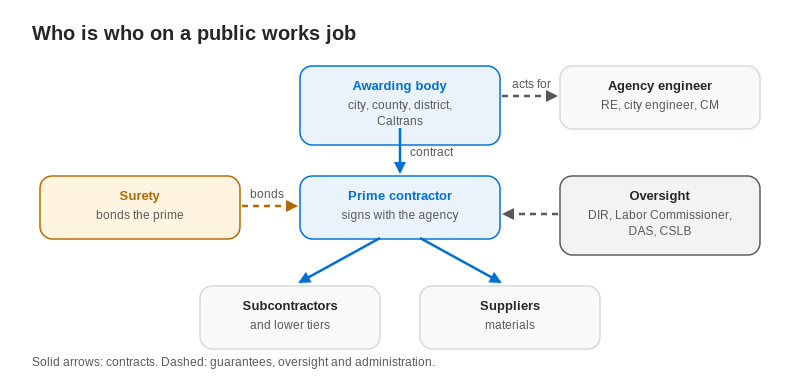
The parties under contract
- Awarding body (the agency): Caltrans, a city, a county, a district. It advertises, awards, pays and accepts the work. Its governing body (city council, board) often has to approve the award and change orders above a limit.
- The agency's engineer: on Caltrans jobs the Resident Engineer; on local jobs a city engineer, construction manager or consultant acting for the agency. Answers RFIs, approves submittals and changes, measures quantities for payment.
- Prime contractor (direct contractor): signs the contract with the agency and is responsible for all the work, including what its subs do.
- Subcontractors: perform part of the work for the prime, or for another sub (lower tier). Listed in the bid when above the threshold. See Listing subcontractors.
- Suppliers: sell materials. They have payment rights too. See Getting paid: preliminary notices, stop payment notices and bond claims.
- Surety: the bonding company that guarantees the prime's bid, performance and payment. See Surety bonding and bonding capacity.
The parties overseeing the job
- Department of Industrial Relations (DIR): registers contractors, publishes prevailing wage rates and receives certified payroll. See DIR public works contractor registration.
- Labor Commissioner's Office: enforces prevailing wage and apprenticeship; can audit and issue penalty assessments. See Labor compliance: audits and penalties.
- Division of Apprenticeship Standards (DAS): apprenticeship programs and ratios. See Apprentices on public works.
- Contractors State License Board (CSLB): licenses.
- Federal agencies on federal-aid jobs, through the state: FHWA rules carried in the contract.
PM notes
Know the names behind each role on your job in the first week: the engineer, the agency's labor compliance contact and your surety's agent. Problems get solved faster when you know who to call.
Common mistakes / what agencies actually check
- Taking direction from an inspector on a change without written authority from the engineer.
- Forgetting that the prime answers for a sub's prevailing wage violations.