
Bid opening, award and protests
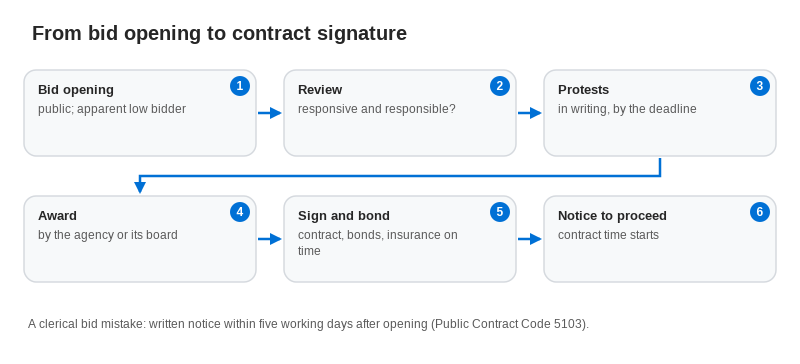
In one sentence: the lowest bid at opening is only the apparent low bid; the award goes to the lowest responsive bid from a responsible bidder, after any protests are resolved.
Bid opening
Bids are opened in public at the stated time. Late bids are returned unopened. The agency reads or posts the totals and later publishes the bid results with every bidder's amount, and for unit price jobs, every item price.
Evaluation
The agency checks the apparent low bid:
- Responsive: bid security, subcontractor list, addenda acknowledged, forms signed, arithmetic. A minor irregularity can be waived; a material one can't.
- Responsible: license, DIR registration, experience and past performance when the documents ask for them.
- Federal-aid forms due after opening, on the days set in the special provisions.
Protests
A bidder that believes the low bid is nonresponsive, or that its own bid was wrongly rejected, can protest. The bid documents set the deadline (often a few business days after opening) and the form. Protests must be specific and in writing. The protested bidder gets a chance to respond, and the agency or its governing body decides before award.
Bid mistakes
A bidder can ask to be relieved of its bid for a mistake under Public Contract Code 5100–5110 if it can show that:
- a mistake was made;
- it gave written notice within five working days after opening, detailing how the mistake occurred;
- the mistake made the bid materially different from what was intended;
- the mistake was in filling out the bid, not an error in judgment or a careless reading of the plans.
Award and signing
After award, the contractor has a set number of days to sign the contract and deliver bonds and insurance. Missing that deadline can forfeit the bid security. Work starts only after the notice to proceed.
Common mistakes / what agencies actually check
- Assuming you've won at opening and ordering material before award.
- Missing the protest deadline because the bid documents put it in an unexpected section.
- Asking for mistake relief for a pricing judgment rather than a clerical error.