
Preparing a public bid
In one sentence: a public bid is judged first on whether it is responsive, meaning complete and exactly in the form asked, and only then on price.
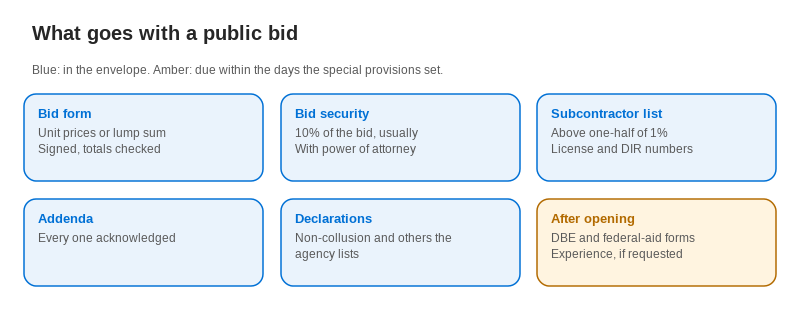
Read the instructions first
The notice to bidders and the instructions to bidders say what's required, in what form and by when. Read them before the plans. Note the documents due with the bid and those due after opening (often within a set number of days).
The bid form
- Unit price contracts (most highway work): you price each bid item per unit; the agency multiplies by its estimated quantities. Extensions and totals must add up. On most agencies' forms, if the extension and unit price disagree, the unit price governs.
- Lump sum contracts (many building jobs): one total, sometimes with alternates.
- Additive or deductive alternates: read how the agency will choose the low bidder; it is stated in the documents.
Forms that usually go with the bid
- Bid security. See Bid security: bid bonds and other forms.
- Subcontractor list. See Listing subcontractors.
- Acknowledgement of every addendum.
- Non-collusion declaration.
- Bidder's experience or qualifications, if asked.
- DIR registration and license numbers.
- On federal-aid jobs, federal certifications and DBE forms as the special provisions require. See DBE requirements on federal-aid jobs.
Responsiveness and responsibility
A bid is responsive when it follows the instructions. A bidder is responsible when it can do the work: license, experience, financial capacity, past performance. An agency can reject the low bid for either reason, but it must follow its own procedures and usually give the bidder a chance to respond.
Before you seal it
A second person checks: every addendum acknowledged, every signature, the bond amount against the bid total, the subcontractor list against the estimate, and the arithmetic.
Common mistakes / what agencies actually check
- Not acknowledging an addendum, even one that changed nothing.
- A bid bond written for a smaller amount than 10% of the final bid after last-minute changes.
- Unbalanced unit prices that the agency can reject as a mathematically unbalanced bid.