
Payment and performance bonds
In one sentence: the performance bond protects the agency if the work isn't finished, the payment bond protects the people who supplied labor and material if they aren't paid, and both are usually 100% of the contract.
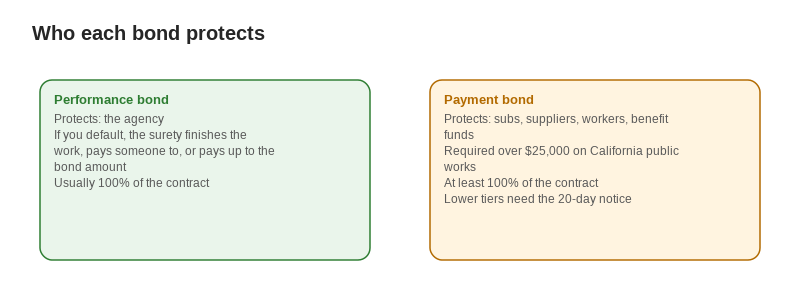
Payment bond
- Required on California public works contracts over $25,000: Civil Code 9550 for local agencies, Public Contract Code 7103 for state entities.
- At least 100% of the contract price.
- Protects subcontractors, suppliers, workers and certain benefit funds and tax agencies that are owed money for the work.
- Claimants who don't have a direct contract with the prime must have given a 20-day preliminary notice (with exceptions for workers and certain funds). See Getting paid: preliminary notices, stop payment notices and bond claims.
Performance bond
- Required by the contract, usually at 100% of the contract price.
- If the agency terminates you for default, the surety may finish the work, pay another contractor to finish it, or pay up to the bond amount.
Delivering the bonds
Bonds are due with the signed contract, on the agency's forms, from an admitted surety, with a power of attorney for the agent who signs. The agency must approve them before work starts.
Change orders
Bonds generally cover changes to the contract; large additions can raise the bonded amount and the premium. Keep your surety informed of major changes.
PM notes
A claim on your payment bond goes to your surety, who will ask you about it. Answer quickly and with documents; an unresolved bond claim affects your bonding capacity.
Common mistakes / what agencies actually check
- Using the surety's standard form when the agency requires its own.
- Not telling the surety about a large change order.
- Ignoring a supplier's bond claim because "we already paid the sub".