
What a Caltrans electrical contractor does
In one sentence: an electrical contractor on a Caltrans job builds the power, communications and field devices that let Caltrans light, signal, watch and manage the highway.
The work
Most Caltrans electrical work falls into a few families of systems:
- Traffic signals at ramps and intersections. See Traffic signals.
- Vehicle detection that counts and measures traffic. See Vehicle detection.
- Highway lighting and sign lighting. See Highway lighting.
- Ramp metering, the signals that release cars onto the freeway. See Ramp metering.
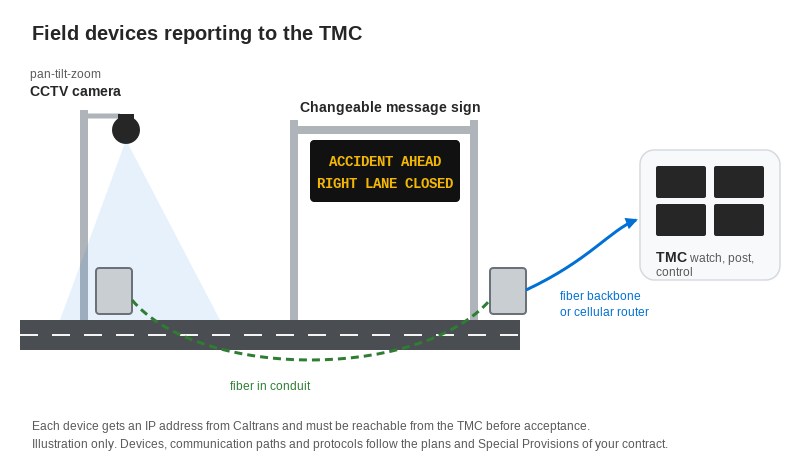
- Traffic monitoring and ITS: cameras, changeable message signs and the stations that report to the Traffic Management Center. See CCTV cameras and video and Changeable message signs.
- Communications that tie it all together: fiber optics, network switches and cellular routers. See Fiber optic communications and Network equipment: switches, routers, SFPs and cellular.
- Power for all of it, from a utility service or, at remote sites, from solar panels and batteries. See Service equipment and utility power and Solar power and LiFePO4 batteries.
Underneath every system is the same civil work: conduit, pull boxes and foundations. That is usually most of the crew's hours.
Who is who
- Caltrans is the owner. On each contract, a Resident Engineer (RE) runs the job for Caltrans, with inspectors in the field.
- The prime contractor holds the contract. On an electrical-only job, the electrical contractor is often the prime; on a larger job (paving, bridges), it is usually a subcontractor to the prime.
- Suppliers furnish the materials and equipment, and specialty subcontractors may handle fiber splicing, boring or striping.
How a job is organized
Every job follows the same arc: read the contract, get submittals approved, order material, build underground, install structures and equipment, test, get Caltrans to accept it, and close out. The Project lifecycle: the twelve phases of a Caltrans electrical job walks through the twelve phases.
The contract itself is a set of documents: the Caltrans Standard Specifications: structure and how to read them, the Special Provisions: what they change and why they win, the Project plans: sheet types, legends and electrical sheets and the Standard Plans: the ES (electrical) series. Knowing how to read them, and which one wins, is half the job. See Order of precedence: which contract document wins.