
How to use this wiki
In one sentence: this wiki explains how Caltrans electrical work runs, from the contract documents to the last test, in plain language and from a contractor's side of the table.
How it is organized
- Start here: the big picture. Read What a Caltrans electrical contractor does and The day-to-day of a GC project manager first.
- Contract documents: the Caltrans Standard Specifications: structure and how to read them, Special Provisions: what they change and why they win, Project plans: sheet types, legends and electrical sheets, Standard Plans: the ES (electrical) series, the The bid package: bid items, quantities and the Bid Item List, and the Order of precedence: which contract document wins that decides which one wins.
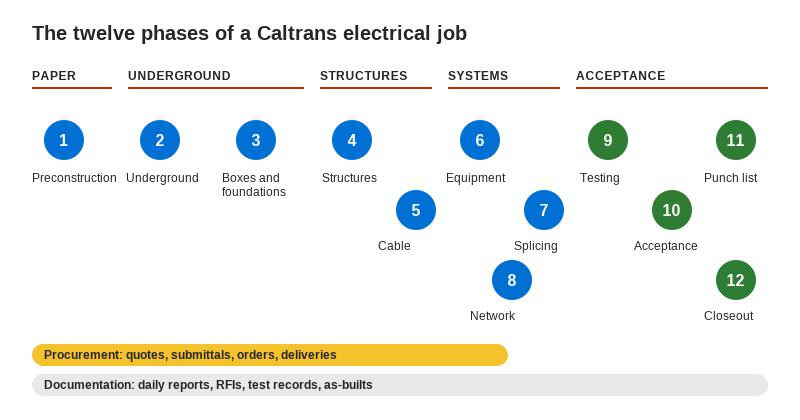
- Project lifecycle: the twelve phases of a job, in order. Start with the Project lifecycle: the twelve phases of a Caltrans electrical job.
- Shared components: what every system is built on: conduit, pull boxes, foundations, conductors, grounding, cabinets and testing.
- Systems: each system Caltrans installs, from traffic signals to fiber optics and solar power.
- PM processes: RFIs, submittals, procurement, daily reports, change orders, acceptance and closeout.
- Glossary: terms and abbreviations. Underlined terms in an article link there.
Reading an article
Each article starts with a one-sentence summary, then explains what the thing is, how it is used on a job, and what a project manager should watch for. Most end with a Common mistakes box: what goes wrong in practice and what Caltrans checks. The sidebar shows the article's sections, linked articles and tags.
What this wiki is not
It is not Caltrans guidance and not a contract interpretation. Section numbers and requirements change between editions, and every contract's Special Provisions change the rules for that job. Always check the documents of your own contract, and ask the Resident Engineer in writing when something is unclear.
Search
Use the search box at the top of every page to find an article or a term.