
Checking your bid before it goes
In one sentence: a quick but disciplined review catches the mistakes that lose money (missing scope, wrong units, arithmetic) and tells you whether your price makes sense against history.
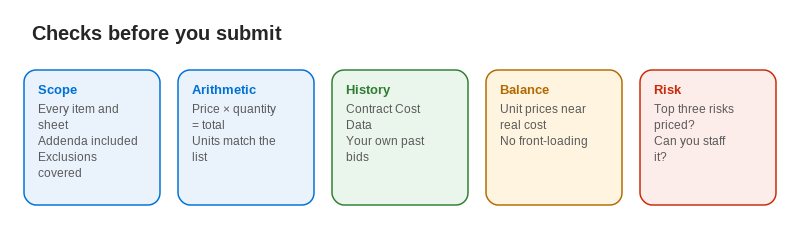
Scope check
- Every bid item priced, every plan sheet taken off, every addendum included.
- Work paid in no item carried somewhere.
- Sub and supplier exclusions covered.
Arithmetic and units
- Unit prices times quantities equal item totals; the total adds up.
- Units match the Bid Item List (each, LF, LS).
- Large items reviewed by a second person.
Comparing with history
Caltrans' Contract Cost Data database lets you search historic bid prices by item, year and district. Use it to compare your unit prices for similar items; Caltrans advises limiting searches to your district and nearby districts and ignoring outliers. Your own past bids and job costs are the better comparison for your crews.
Balanced bids
On unit price items, keep each price close to its real cost plus a fair share of overhead and profit. Heavily unbalanced bids (very high prices on some items, very low on others) can be rejected, and they backfire when quantities change. On lump sum systems, the later cost breakdown should also be reasonable.
Risk questions before committing
- Which three items carry the most risk, and is that risk priced?
- Can you staff it when it runs?
- Is the margin enough for the risk? See Saying no: which jobs to pass on.
PM notes
Keep a one-page bid summary: totals by cost type, labor hours, crew-days, key assumptions, plugs used, and who approved the final price.
Official sources
Common mistakes / what Caltrans actually checks
- Checking the total but not the units.
- Using a statewide average from another district as your price.
- Front-loading items to get cash early.