
Project lifecycle: the twelve phases of a Caltrans electrical job
In one sentence: a job moves from paper to pipe to wire to equipment to tests, and each phase depends on the one before it.
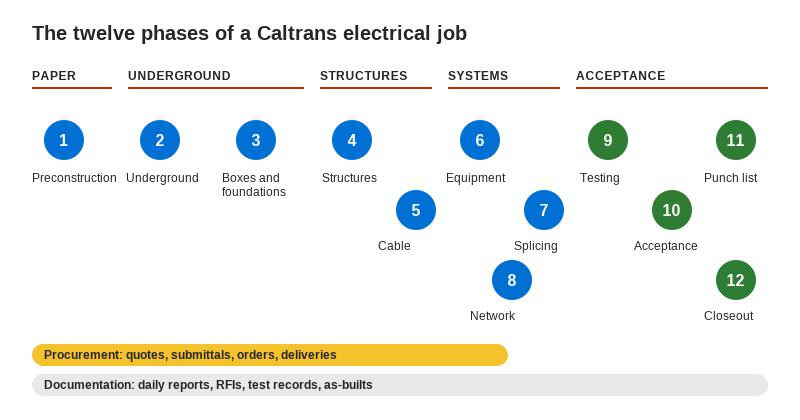
The flow
Design review → RFIs → submittals → procurement → underground conduit → pull boxes → foundations → poles and cabinets → conductors and fiber → equipment → configuration → testing → Caltrans acceptance → punch list → closeout.
| Phase | What happens | PM focus |
|---|---|---|
| 1. Phase 1: Preconstruction and design review | Read the contract, find conflicts, submit, order long-lead items | Submittals, RFIs, baseline schedule |
| 2. Phase 2: Underground construction | Survey, potholing, trenching or boring, conduit | Utility conflicts, lane closures |
| 3. Phase 3: Pull boxes and foundations | Pull boxes, vaults, cabinet and pole foundations | Inspections before concrete |
| 4. Phase 4: Structure installation | Poles, cabinets, solar assemblies | Deliveries arriving in order |
| 5. Phase 5: Cable installation | Conductors, fiber and communication cable | Conduit proven clear first |
| 6. Phase 6: Equipment installation | Switches, routers, cameras, power equipment | Approved equipment only |
| 7. Phase 7: Fiber splicing and termination | Fusion splicing, termination, fiber tests | Splice plan and test records |
| 8. Phase 8: Network and system configuration | IP addresses, VLANs, remote access | Caltrans network requirements |
| 9. Phase 9: System testing | Electrical, communication and functional tests | Test reports |
| 10. Phase 10: Caltrans acceptance testing | Caltrans witnesses tests | Scheduling with the RE |
| 11. Phase 11: Punch list | Fix every deficiency | Closing items fast |
| 12. Phase 12: Project closeout and delivery | As-builts, certificates, warranties, final quantities | Getting paid in full |
How procurement runs through it
Procurement isn't a phase; it runs alongside all of them. Long-lead equipment ordered in phase 1 has to arrive in phases 4 to 6. Late equipment is the most common reason an electrical job finishes late. See Procurement and long-lead items.
Four systems, one job
Everything you order supports one of four systems: civil (conduit, concrete, pull boxes), electrical (conductors, breakers, grounding), communications (fiber, cable, switches, routers) and power (utility service, or solar and batteries).