
Labeling and identification
In one sentence: labels let Caltrans maintenance find and fix things for the next twenty years.
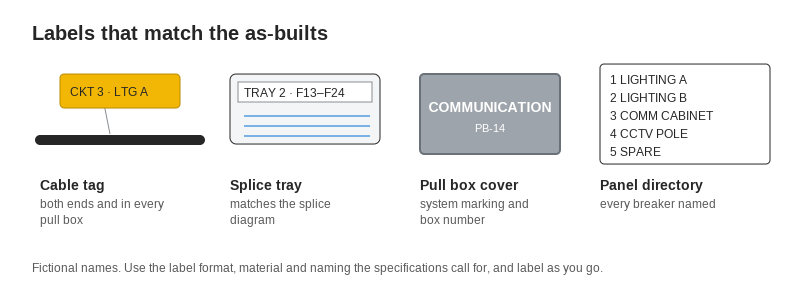
What gets labeled
- Conductors and cables at both ends and in every pull box.
- Fibers, splice trays and patch panel ports, matching the splice diagram.
- Pull box covers with the system marking.
- Cabinets, breakers and equipment, matching the as-builts.
Good practice
- Use the label format and material the specifications call for: durable, readable, weather-proof.
- Label as you pull and terminate, not at the end.
- Keep labels consistent with the plans, the splice diagram and the as-builts.
Why it matters
Labeling is one of the most frequent findings in Phase 10: Caltrans acceptance testing. Fixing labels after the fact means reopening boxes and cabinets, often with a lane closure.
Common mistakes / what Caltrans actually checks
- Labeling at the end instead of during installation.
- Labels that don't match the as-builts.
- Paper or marker labels that fade.