
Pricing labor: crews and production rates
In one sentence: labor is the riskiest part of an electrical estimate, so price it as crews times days, using production rates from your own past jobs and the prevailing wage rates that apply to the project.
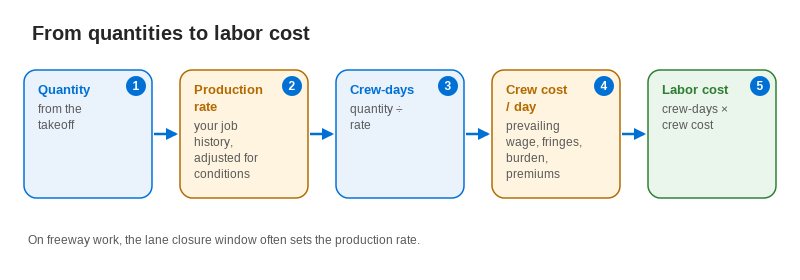
The basic calculation
- Quantity from the takeoff (for example, feet of 2-inch conduit in trench).
- Production rate: how much one crew installs per day in these conditions.
- Crew-days = quantity / production rate.
- Crew cost per day: each worker's hourly cost × hours, plus the crew's small tools and truck.
- Labor cost = crew-days × crew cost per day.
Crew cost
For each classification on the crew (for example inside wireman, laborer, operator, apprentice):
- the prevailing wage basic rate and fringe benefits for the county and craft, from the determination that applies on the bid advertisement date (see Prevailing wage);
- payroll taxes and workers' compensation (your burden);
- overtime and shift premiums where the work requires them.
Production rates
- Use your own job cost history first: what the crew really achieved on similar work. See Job costing: knowing what each job really made.
- Adjust for conditions: night work, lane closure windows, hard digging, structure-mounted conduit, traffic, travel to scattered locations.
- On freeway work, the closure window often controls production more than the work itself.
Night work, overtime, travel
- Caltrans often limits work to specific hours and lane closures in the special provisions. Price the real working hours per shift, not eight.
- Overtime and shift premiums from the wage determination.
- Travel time and subsistence where the determination requires them.
Supervision
Foreman and general foreman time, and the PM's field time if it's charged to jobs, belong in labor or field overhead, not forgotten.
PM notes
Write the production rates and the crew you assumed into the estimate. When you win, the foreman gets the same numbers as the job's target.
Common mistakes / what Caltrans actually checks
- Using a production rate from a daytime job on a night closure job.
- Pricing classifications without fringe benefits or burden.
- Forgetting the time to set up and remove traffic control in each shift.