
Project plans: sheet types, legends and electrical sheets
In one sentence: the project plans show what to build on this job and where; the electrical sheets are the ones your crew will live in.
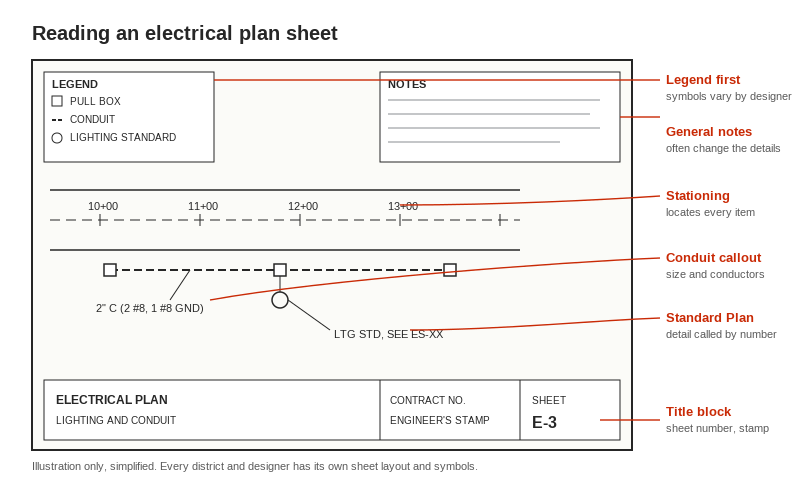
How a plan set is organized
A Caltrans plan set is a stack of sheets grouped by discipline. A typical order is: title sheet and location map, typical cross sections, layouts, construction details, stage construction and traffic handling, drainage, utilities, then the specialty sheets such as electrical, signs and striping, and structures. Each sheet has a title block with the sheet number, the total number of sheets, the contract number and the engineer's stamp.
The electrical sheets
Electrical sheets usually include:
- Electrical legend and abbreviations: the symbols for pull boxes, conduit, poles, cabinets and devices. Read it first; symbols differ between districts and designers.
- Plan sheets (layouts): where each pull box, conduit run, pole and cabinet goes, with stationing and offsets.
- Schedules and details: conductor and conduit schedules, pole and equipment schedules, wiring diagrams, cabinet details and system block diagrams.
- Communication sheets on ITS jobs: fiber routes, splice diagrams and network diagrams.
The plans refer to standard details by Standard Plan number instead of drawing them. See Standard Plans: the ES (electrical) series.
How a PM uses them
- Takeoff: count devices and measure conduit and conductor runs to check the bid quantities. Note what is paid as a bid item and what is included in another item.
- Submittals and procurement: the schedules name the equipment to submit and order. See Submittals: what Caltrans expects.
- Field layout: stationing and offsets tell the crew where to stake. Written dimensions govern over scaling the drawing. See Order of precedence: which contract document wins.
- As-builts: mark changes on a set of plans as the work happens; it becomes the as-built record at closeout. See Closeout package checklist.
When the plans disagree
If the plans conflict with the Special Provisions: what they change and why they win, the Special Provisions govern. If the plans conflict with the field (a utility, a slope, a sign in the way), write an RFI. See Writing RFIs.
Common mistakes / what Caltrans actually checks
- Skipping the electrical legend and misreading a symbol.
- Scaling dimensions instead of using stationing and written dimensions.
- Taking off quantities from one sheet and missing the schedule on another.
- Not keeping a marked-up set during construction, then rebuilding the as-builts from memory.