
Service equipment and utility power
In one sentence: the service is where the utility's power becomes Caltrans's power, and getting it energized is often on the critical path.
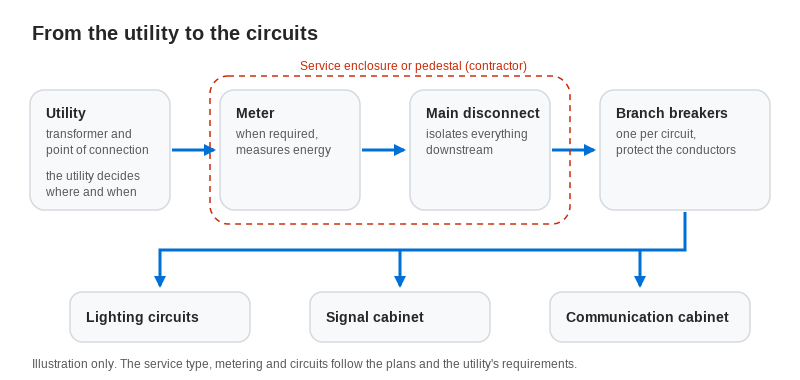
What it includes
| Item | What it is for |
|---|---|
| Service enclosure or pedestal | Houses the meter, main disconnect and breakers |
| Meter (when required) | Measures energy for the utility bill |
| Main disconnect and breakers | Isolate and protect circuits |
| Service conductors | From the utility point of connection to the enclosure |
| Grounding | Ground rods and bonding at the service. See Grounding and bonding |
Details are on the Standard Plans: the ES (electrical) series and the project plans.
Utility coordination
The utility (for example, the local power company) decides the point of connection and schedules the connection. That usually takes an application, a service request from the agency, and inspection. Lead times can be long.
PM notes
- Start the service request in phase 1; ask the Resident Engineer who files it on this contract.
- Plan temporary power or a generator if equipment must run before the service is energized.
- Sites with no practical utility service use solar. See Solar power and LiFePO4 batteries.
Common mistakes / what Caltrans actually checks
- Starting the utility service request too late.
- Enclosure installed in a different location than the utility approved.