
Caltrans Standard Specifications: structure and how to read them
In one sentence: the Standard Specifications are the rulebook that applies to every Caltrans contract. They tell you how work must be done, what materials are acceptable, how it is measured and how you get paid.
What they are
Caltrans publishes the Standard Specifications as one large book that is updated every few years. Every contract you bid on names the edition that applies, and that edition is part of the contract — even though it is not printed in your bid package.
The Standard Specifications are generic: they are written for every highway project in the state. What makes them specific to your job is the combination with:
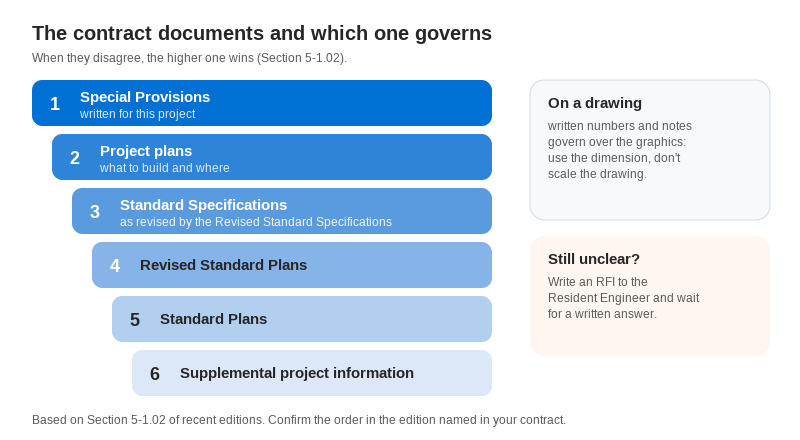
- the Special Provisions: what they change and why they win, which modify and add to the specs for this project,
- the project plans, which show what to build and where,
- the Standard Plans: the ES (electrical) series, which show standard details (pull boxes, foundations, conduit installation).
When these documents disagree, a defined Order of precedence: which contract document wins decides which one wins.
How the book is organized
The specifications are divided into divisions, and each division into numbered sections. A reference such as 86-2.05 reads as Section 86, subsection 2, paragraph 05.
| Part | What it covers | Why it matters to an electrical PM |
|---|---|---|
| Sections 1–9 — General provisions | Definitions, bidding, award, scope, control of work, legal relations, prosecution and progress, payment | Submittals, schedule, change orders, payment and claims all live here |
| Sections 10–16 — General construction | Work zone and traffic control, water pollution control, environmental stewardship, existing facilities | Every freeway job: lane closures, BMPs during trenching, protecting existing equipment |
| Earthwork, concrete, paving sections | Excavation and backfill, concrete, asphalt and concrete repair | Trench backfill, foundations, pull box surrounds, patching after trenching |
| Section 86 — Electrical systems (general) | Requirements common to all electrical work: conduit, pull boxes, conductors, splicing, grounding, service, foundations, testing | The section you will open most often |
| Section 87 — Electrical systems (specific) | Each system: signals, lighting, detection, ramp metering, traffic monitoring, communications, fiber optics | Where system-specific materials and tests are defined |
Section numbers follow the recent editions of the book. Always confirm against the edition named in your contract.
Anatomy of a section
Most sections follow the same pattern. Once you know it, you can find anything quickly:
- General — scope, definitions, submittals required, quality control.
- Materials — what is acceptable (standards, ratings, approved products).
- Construction — how to install it.
- Payment — how the item is measured and paid (per linear foot, each, lump sum).
For a PM, the two parts you read first are Submittals (what you must send before ordering or installing) and Payment (what you are actually paid for, and what is included in another item at no extra cost).
How a PM uses them day to day
- Bidding: read the payment clause for each bid item so you know what is included in the price — for example, whether trenching and backfill are paid separately or included in the conduit item.
- Preconstruction: list every submittal the relevant sections require and build the submittal log from it. See Submittals: what Caltrans expects.
- Procurement: check the Materials subsections before you request quotes, so the supplier quotes a product that will be approved. See Procurement and long-lead items.
- In the field: when the crew asks "how deep?" or "what backfill?", the answer is in the Construction subsection — unless the special provisions or plans say otherwise.
- Testing and closeout: the required tests and documentation are listed in the sections; they become your acceptance checklist. See Caltrans acceptance testing and the punch list.
The rule that saves the most trouble
Never read the Standard Specifications alone. Before relying on any clause, check whether the special provisions for your project modify it. Many electrical requirements — approved equipment, communication hardware, testing procedures — are changed or added in the special provisions for each contract.
Common mistakes / what Caltrans actually checks
- Pricing from the spec book without reading the special provisions that change it.
- Missing a required submittal because it was listed in a general section, not the electrical one.
- Ordering material that meets "industry standard" but not the specific requirement in the Materials subsection.
- Using an older edition of the book than the one named in the contract.
This page is for learning only. It is not affiliated with or endorsed by Caltrans, and it is not a contract interpretation. Always refer to the contract documents for your project.