
Order of precedence: which contract document wins
In one sentence: when two parts of a Caltrans contract disagree, Section 5-1.02 of the Caltrans Standard Specifications: structure and how to read them lists which one governs, starting with the Special Provisions: what they change and why they win.
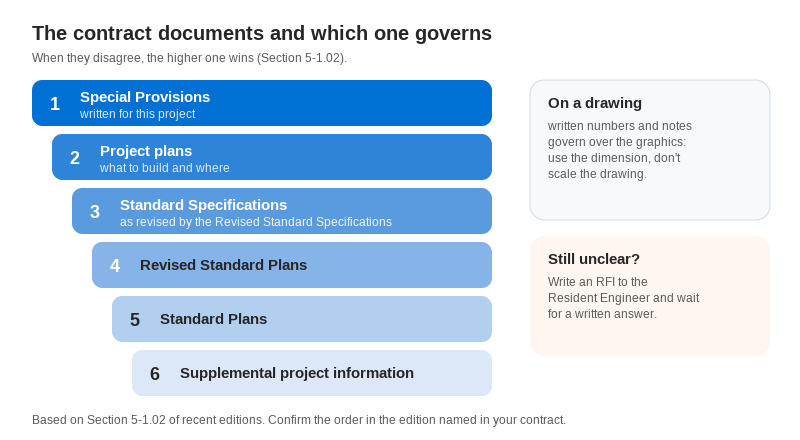
The order
Section 5-1.02 (Contract Components, in Section 5, Control of Work) lists the parts of the contract in the order they govern when there is a discrepancy:
- Special Provisions
- Project plans
- Standard Specifications (as revised by the Revised Standard Specifications)
- Revised Standard Plans
- Standard Plans
- Supplemental project information
The same section adds one more rule: on a drawing, written numbers and notes govern over the graphics. If a dimension is written on the plan, use it; don't scale the drawing.
What it means in practice
- Special Provisions over everything: if the Special Provisions call for a different pull box, conductor or test than the plans or the book, follow the Special Provisions.
- Project plans over the book and the Standard Plans: the plans show this job. If a detail on the project plans differs from the Standard Plan it refers to, the project plan wins.
- Revised Standard Plans over Standard Plans: when a Standard Plan sheet has been revised since the edition you are using, the revised sheet is included with the contract and replaces it.
- Supplemental project information last: reports and reference material (for example, geotechnical or utility information) inform the work but don't override the contract requirements above it.
When the order isn't enough
The order of precedence settles conflicts between documents. It doesn't settle:
- a requirement that is unclear rather than contradictory,
- a conflict inside one document,
- a conflict between the documents and what you find in the field (a utility where the conduit should go, a foundation that doesn't fit).
In those cases, write an RFI to the Resident Engineer, describe the conflict with sheet and section references, and propose a solution. Keep working on what isn't affected, and don't build the disputed item until you have a written answer: work done on a guess may not be paid.
A quick check before you build
- Find the requirement in the Special Provisions (same section number as the book).
- Check the project plans and their notes.
- Check the Standard Specifications and any Revised Standard Specifications.
- Check the Revised Standard Plans, then the Standard Plans.
- Still unclear? RFI.
Based on Section 5-1.02 of recent editions. Always confirm against the edition named in your contract.
Common mistakes / what Caltrans actually checks
- Scaling a dimension off the plans when a written dimension or note says otherwise.
- Following a Standard Plan detail when the project plans show something different.
- Using a superseded Standard Plan sheet instead of the Revised Standard Plan included with the contract.
- Building a disputed item before the RFI is answered.